RovePlan

Winter & Sub-Freezing Cold-Weather RV Camping Checklist

Reviewed by RovePlan Editorial TeamUpdated 2026-11-198 min guide25 items in default profile (19 essential · 26 in full list)

A 25-item cold-weather gear and freeze-prevention checklist for shoulder-season mountain passes and sub-freezing winter RV trips across the US.

Disclosure: As an Amazon Associate, RovePlan earns from qualifying purchases. Read full disclosure.

Filter, Customize & Print Checklist

Trip Profile

All rigs · All Hookup Types · Winter · 2-3 nights · 2 travelers

0 / 25 items packed (0%)19 essential remaining

Print blank for a pen-and-paper clipboard list, or check items below first.

0 of 25 checked

Prints cleanly with pen-ready checkboxes (blank or filled).

Add Custom Trip Item (Saved Locally)

19 essential remaining

0/25 packed

Packing & Pre-Trip Field Notes

Why You Still Need Propane Even With 50A Shore Power in Winter

Electric space heaters save propane inside the living cabin, but they do not circulate warm air through the basement ducting where fresh water manifolds and tank valves live. Set your propane furnace a few degrees below your electric heater—or run the furnace periodically at night—so warm air continues protecting your underbelly plumbing.
Protecting Hoses, Hydrants & Holding Tanks Below 20°F

Water freezes fastest at exposed brass fittings and the campground riser pipe before the heated hose even begins. Insulate the park spigot and pressure regulator inside a foam faucet cover, keep gray and black dump valves strictly closed until ready to dump in a single fast flush, and add non-toxic pink propylene glycol RV antifreeze to P-traps during severe cold snaps.

Visual Shore Power & Water Hookup Reference

Technical illustrations of standard US campground shore power and potable water hookup sequence (always confirm ratings in your RV owner's manual).

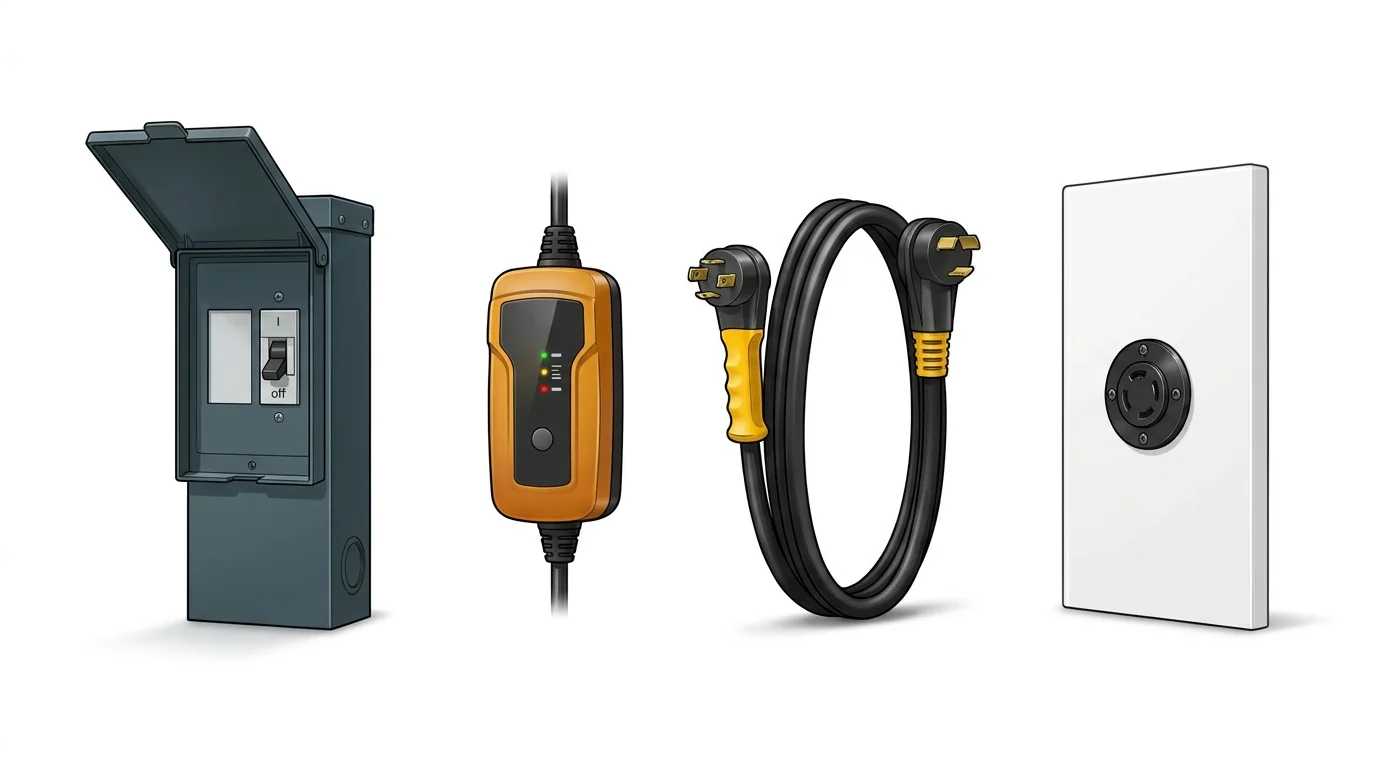
Safe Shore Power & Fresh Water Hookup Sequence

Protect coach electronics & PEX plumbing

ELECTRICAL (30A TT-30P / 50A 14-50P) — TURN BREAKER OFF BEFORE PLUGGING

Illustration: Four-step US RV shore power hookup sequence from left to right: campground power pedestal with breaker off, inline EMS surge protector, heavy-duty 30A/50A shore cord, and RV twist-lock shore power inlet
  1. 1. Pedestal

    Breaker OFF first

  2. 2. EMS Surge Guard

    Verify polarity & voltage

  3. 3. RV Shore Cord

    Lock twist-ring inlet

  4. 4. Breaker

    Switch ON

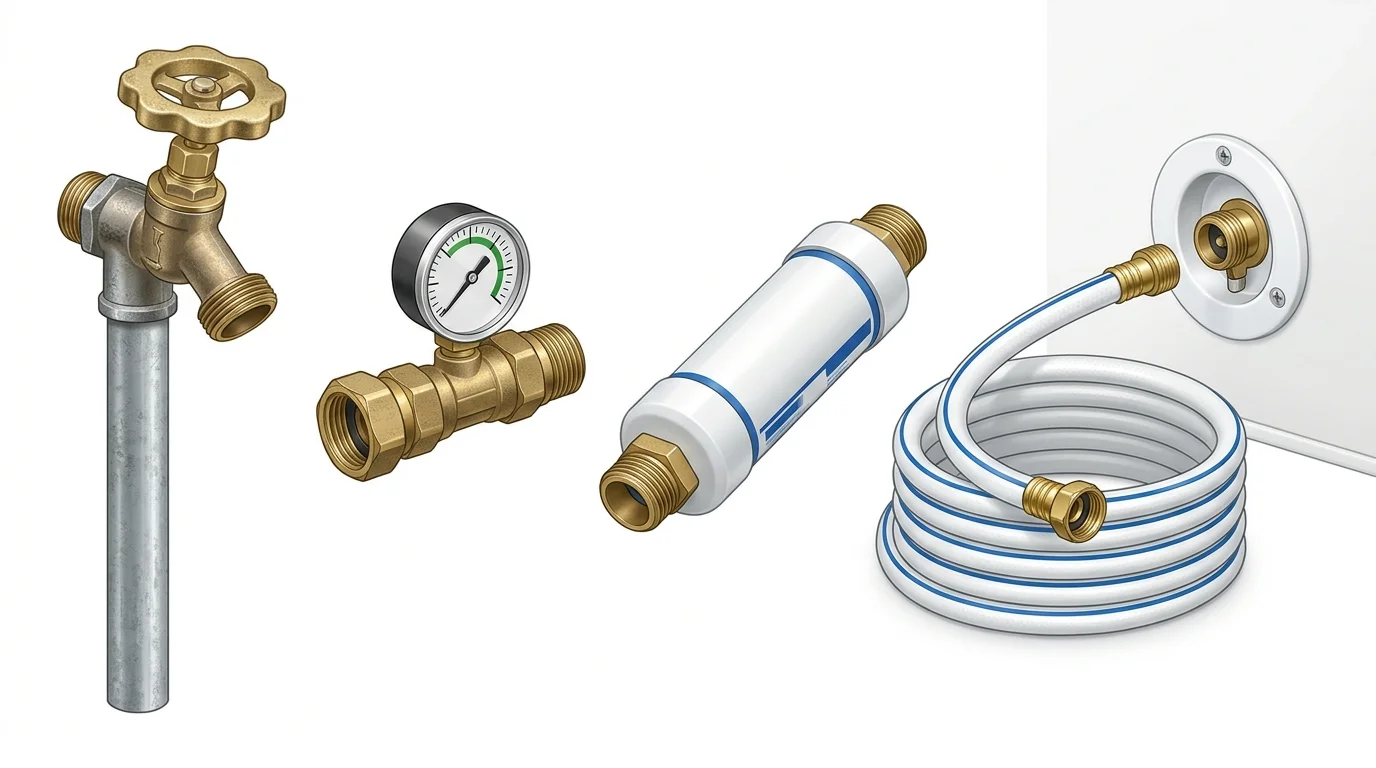
POTABLE WATER (NSF/ANSI 61) — FLUSH SPIGOT BEFORE ATTACHING HOSE

Illustration: Four-step US RV fresh water hookup sequence from left to right: campground water spigot, brass 40 to 50 PSI pressure regulator with gauge, inline potable filter cartridge, and drinking water hose to RV city water inlet
  1. 1. Camp Spigot

    Flush 10 seconds

  2. 2. Pressure Regulator

    Clamp to 40–50 PSI

  3. 3. Inline Filter

    Follow arrow direction

  4. 4. Potable Hose

    To RV City Inlet

Why We Specify These Hardware Ratings

  • EMS vs. Basic Surge Strips: Full Electrical Management System (EMS) units cut power during open neutrals, reverse polarity, or sustained low-voltage brownouts—basic surge strips only absorb brief spikes.
  • 40–50 PSI Lead-Free Brass Regulators: Unregulated US park spigots can exceed 80–100 PSI; capping pressure protects interior PEX crimps and water heater check valves.
  • NSF/ANSI 61 Potable Hoses: Residential green garden hoses are not certified food-grade and can leach plasticizers into coach lines.
  • 15A Household Adapters: Limited strictly to ~1,500W for battery charging and lights—never power roof A/C compressors or electric water heaters through a 15A outlet.

US Safety Standards & Reference Sources

Always verify exact specs in your coach and tow-vehicle owner's manuals.

Field Guide: Key Specs, Pitfalls & Timing

Winter RV Quick Reference

Key Numbers & Rules of Thumb

  • Propane burn rate: a 25,000–35,000 BTU RV furnace running continuously in 15°F weather can empty a standard 20-lb cylinder (~430,000 BTU) in 24 to 36 hours.
  • Propane vaporization limit: liquid propane stops boiling into gas at -44°F, and heavily drawn tanks in single-digit weather lose pressure before reaching empty.
  • Water freeze workaround: below 20°F, disconnect your heated hose at night after topping off the interior fresh tank and run strictly on the onboard 12V pump.
  • Battery cold penalty: flooded lead-acid batteries lose ~30–40% capacity at 20°F, and LiFePO4 batteries MUST NOT be charged below 32°F unless internally heated.

Common Rookie Mistakes to Avoid

  • Leaving the gray/black tank dump valves cracked open while hooked up in sub-freezing weather—trickling water freezes into a solid ice dam inside the sewer hose.
  • Heating strictly with portable 1,500W electric space heaters: the furnace stays off, leaving underbelly heat ducts cold so hidden PEX pipes and holding tanks freeze solid.
  • Sealing every roof vent tight while cooking and sleeping—human breath dumps pints of water into cold walls/mattresses without cracked ventilation and a dehumidifier.
  • Skipping winter RV skirting or insulated vent pillows during multi-night sub-20°F stays.

Pre-Trip Timing & Prep

  • 7 days out: test 12V tank heating pads, fill twin 30-lb propane tanks (or pack an external Stay-A-While propane hookup), and pack rated tire chains.
  • Arrival before dark: verify pedestal delivers full voltage on EMS (winter parks sag during heavy heater draw), plug in heated hose, and insulate outside spigot.
  • Nightly freeze routine (<25°F): crack bathroom cabinet doors containing PEX manifolds, check the propane auto-changeover indicator and ultrasonic tank sensor, and crack a roof vent 1/4 inch.

Frequently Asked Questions

Does running a space heater keep RV holding tanks from freezing?
Usually no. Most RV underbellies rely on warm air ducted from the central propane furnace. Running only an electric space heater inside the living area satisfies the main thermostat, which prevents the furnace from cycling and can allow underbelly pipes to freeze.
Should I leave my gray and black dump valves open during freezing weather?
Never leave black or gray valves open in freezing weather. Slow trickles freeze inside the external sewer hose, creating a solid ice blockage. Keep valves closed until tanks are at least two-thirds full, then dump all at once.
What temperature requires a heated RV water hose?
Connect a thermostatically controlled heated water hose whenever overnight temperatures are forecast at or below 32°F, and wrap the campground metal hydrant and brass pressure regulator with an insulated cover.
How do I reduce window condensation inside a camper in winter?
Run a compact electric dehumidifier or moisture absorber tubs, crack a roof fan slightly when cooking or showering, and fit custom Reflectix foil panels inside single-pane windows to prevent warm moist air from contacting cold glass.
View all 15 checklists →